How to Frame your Response to Teacher Interview Questions

Answering interview questions makes almost everyone nervous, and a little anxiety is actually healthy. It means you care about the position. Too much, though, becomes self-sabotage.
Some candidates chase the “perfect” answer, overthinking while a dozen competing thoughts collide. It is inefficient and exhausting. Others do the opposite: they launch straight into a response, grabbing at disparate ideas and trying to stitch them together on the fly. The result is usually an answer that lacks clarity and trails off in under a minute.
There is a better way. Applying a framework, a simple structure of ideas and rules, lowers your anxiety to a healthier level and produces a more coherent, compelling answer. Here is the framework, step by step.
The five-step answer framework
Understand the question
Hear what is really being asked, beyond the surface wording.
State your philosophy and values
Open with a belief that frames everything that follows.
Describe your pedagogical approach
Get specific enough to paint a picture for the committee.
Explain the benefits
Name one or two payoffs for students and learning.
Give a real-life example (optional)
A short, true story when it adds value, not filler.
TEACHING
PREP KIT
The Teacher Interview Prep Kit
- The 10 most-asked interview questions
- A proven framework for answering each
- Space to draft your own answers
Throughout the steps below, we will use one running example: “Describe the first five minutes of your daily classroom routine.” Watch how the framework turns it from a list of behaviors into a thoughtful, values-driven answer.
Step 1Understand the question
Listen actively, and answer only once you fully understand what is being asked. If any part is unclear, just ask: “Would you mind rephrasing the question?” Interviewers far prefer that to an improvised, misplaced answer.
If you heard it correctly, pause and consider what the question is really trying to learn about you at a higher level. What is the essence of it? The “first five minutes” question looks like it is about specific behaviors at the start of class, but at heart it is about your approach to classroom management, how you build relationships and establish routines. Spotting that nuance sets up step two.
Step 2State your philosophy and values
Your values are what guide your practice, and teaching is ultimately about connecting with other people in a genuine way. Leaning into what you stand for and what you care about gives the committee a window into your authentic self. Remember, they are interviewing you not only as a teacher but as a future colleague.
So open with a brief statement of the values tied to what is really being asked:
Step 3Describe your pedagogical approach
Now address the question directly with specific strategies, vivid enough to create a mental picture, and tie each one back to your value statement:
Step 4Explain the benefits
Briefly name one or two benefits of those strategies:
Step 5Provide a real-life example
Examples can come from anywhere: classroom observations, work as a para-educator or aide, volunteering with kids, even parenthood. This step is optional unless the committee asks for one. Use your judgment, does a concrete story add value, or is it filler? A good rule of thumb is to offer an example when the interviewers seem to want more, perhaps asking, “Would it help if I shared a real-life example?” A compelling, true anecdote about how your approach helped a specific student can be the thing they remember.
Practice until it is automatic
Two things make the framework work: knowing the steps, and practicing them across many different questions until applying them feels automatic. That practice offloads much of the anxiety and leaves you more confident in the moment. The framework lays out a clear path to concise, thoughtful answers, even to the toughest questions a committee can throw at you.
“Dr. Hougan's passion and book directly contributed to my success landing contract after contract.”— Tessa Acay, Third-Year Teacher
Apply this framework to every question
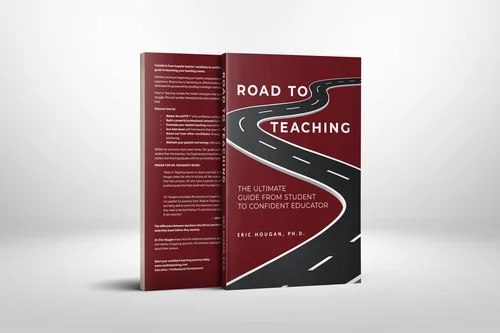
This is one technique from the book. Road to Teaching walks the same framework across every interview category with worked examples, plus behind-the-table perspectives from a principal and a career counselor — and the whole journey from student teaching through signing your first contract.